Tea Cup with Flowers SVG
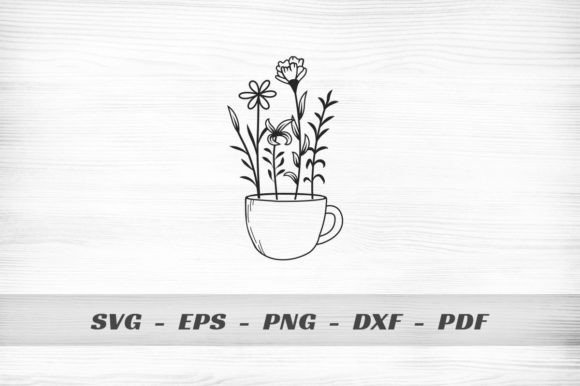
As a designer who’s stitched hundreds of embroidery projects—from boutique aprons to Etsy bestsellers—I opened Tea Cup with Flowers SVG expecting charm. What I found was something more useful: quiet confidence. It’s not flashy, but it’s *considered*. The cup sits gently centered, stem clear, handle curved just enough to read as functional—not decorative only. Delicate florals spill from the rim and trail softly along the base, balanced but not symmetrical. No fussy stems or overlapping petals that would vanish under satin stitch. This isn’t a “more is more” design—it’s a “just enough” one. And in embroidery, that’s where real usability begins.
A Tote Bag That Feels Like a Gift, Not a Gimmick
Last week, I prepped a custom order: a linen-cotton tote for a local tea shop’s grand opening. Their brief? “Warm, handmade, not cutesy.” I pulled up Tea Cup with Flowers SVG and sized it to 3.75” wide—just right for the front pocket area. No resizing drama. No pixelation in the PNG preview. When I stitched it onto medium-weight woven fabric with tear-away + light cutaway stabilizer, the curves held. The flower outlines stayed crisp, the cup’s inner curve didn’t pull or pucker, and the fill stitches laid flat without overloading the fabric. Customers don’t see “stitch density”—they feel it. And this design delivers softness, not stiffness.
Where It Shines (and Where It Asks for Thought)
Tea Cup with Flowers SVG belongs on pieces that invite pause: baby onesies (gentle, non-distracting), kitchen towels (the floral trail reads beautifully across a folded edge), pillow covers (its vertical flow suits center placement), and lightweight sweatshirts (no heavy fill = no stiffness). It works especially well as an embroidered patch—clean outer edges, minimal interior detail—so it presses cleanly and layers neatly on denim or canvas.
But here’s what I checked before committing:
- Hoop size matters. The full motif fits comfortably in a 4x4 hoop—but if you’re adding monogram initials below or framing it with a border, confirm your machine’s max stitching area first.
- Fabric texture changes everything. On terry cloth towels, I reduced fill stitch density slightly and added a floating stabilizer layer underneath. On thin rayon-blend tees? I skipped dense satin stitch on the cup’s inner curve and used running stitch instead—kept it breathable and wash-safe.
- Dark fabric needs contrast testing. I ran a quick black-and-white mockup: the cup outline stays legible, but tiny flower centers fade on navy unless stitched in ecru or pale gold thread. Always test thread colors on scrap first.
- Curved surfaces need planning. For caps or curved mugs (via vinyl transfer), I’d isolate the cup silhouette only—drop the trailing florals. They’re lovely on flat goods, but lose clarity when stretched.
Why Small Businesses Reach for This Design Again and Again
This isn’t just another floral clipart file. As a craft business owner, I’ve watched how Tea Cup with Flowers SVG performs in listings: higher click-through on Etsy because it reads as *intentional*, not generic. Buyers scroll past busy designs—they stop for things that feel curated. That subtle asymmetry? It signals handmade care. The clean lines? They translate well into printable mockups for social media or product tags. And because it’s offered as both SVG and transparent PNG (300 DPI), I can drop it straight into Canva for digital previews, then switch to my embroidery software without re-tracing.
It also scales ethically. I’ve used it for personal gifts (a stitched mug cozy for my sister’s birthday) and commercial embroidery (a set of six nursery pillows sold through a local boutique). Since the listing confirms it’s licensed for commercial use—and includes both vector and raster formats—I didn’t hesitate to list finished products. But I always double-check: if you’re reselling digital files or bundling with other Graphics, verify license scope directly with the seller. Clarity here protects your craft business long-term.
Real Embroidery Designer Notes—Not Just Theory
Before stitching Tea Cup with Flowers SVG on your next project, do these five things:
- Run a test on scrap fabric matching your final substrate—especially if using textured, stretchy, or dark material.
- Check small details at actual stitch size: those flower centers should be at least 1.5mm wide to avoid disappearing under thread coverage.
- Review stitch direction in your embroidery software—adjust so satin stitch follows the cup’s curve, not fights it.
- Use proper stabilizer: light cutaway for knits, tear-away for stable wovens, and fusible + topping for napped fabrics like terry.
- Ask yourself: does this elevate the *product*, or just fill space? With Tea Cup with Flowers SVG, it consistently elevates—when placed thoughtfully, stitched cleanly, and paired with intentional thread choices.
Final Thought: It’s Not Just a Design—It’s a Quiet Signature
In a market flooded with oversized florals and over-digitized motifs, Tea Cup with Flowers SVG stands out by holding space—not taking it. It doesn’t shout. It invites. That makes it ideal for brands building recognition through consistency: the same delicate cup on a holiday tea towel, a baby blanket, and a wedding favor bag creates cohesion without repetition. It’s proof that Print Templates and Graphics don’t have to sacrifice personality to be practical. As an embroidery file, it’s reliable. As a design asset, it’s quietly versatile. And for anyone making, selling, or gifting with intention? That’s not just usable—it’s trustworthy.